Noise, Interruptions, and Turnover: The Real Price Tag of a Poorly Designed Open Office

The Promise That Didn't Deliver
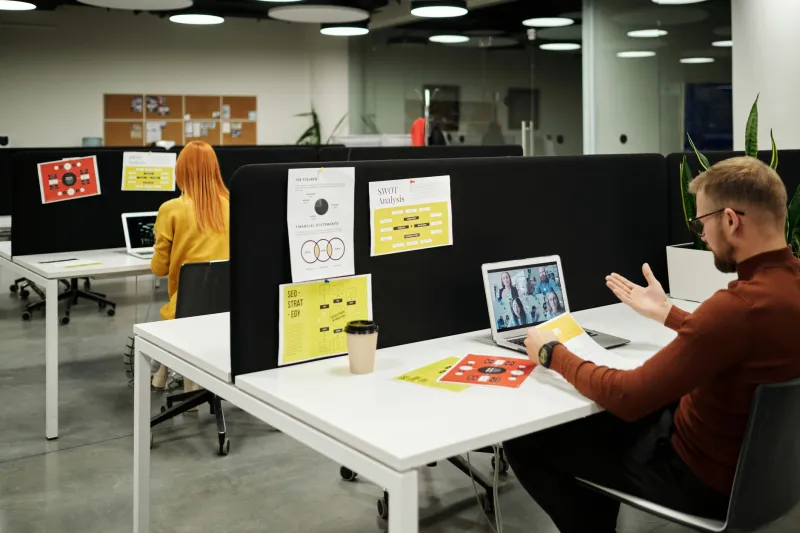
When open office layouts swept through corporate America in the 1990s and accelerated into the 2000s, the logic seemed sound. Remove the walls, reduce the square footage per employee, and watch collaboration flourish. Decades later, the evidence tells a more complicated story.
Research from the University of California, Irvine found that it takes an average of 23 minutes for an employee to fully regain concentration after a single interruption. In a typical open office environment, workers report being disrupted anywhere from four to seven times per hour. Do that math across an eight-hour workday, and you are not looking at a minor inconvenience—you are looking at a structural collapse of deep, focused work.
For organizations still operating under the assumption that open layouts are a net positive, the financial implications deserve serious scrutiny.
Quantifying the Productivity Gap
The figure of $15,000 in annual lost productivity per employee is not hyperbole. It is grounded in a convergence of labor economics and workplace research. Consider the following inputs:
The average fully-loaded cost of a knowledge worker in the United States—salary, benefits, payroll taxes, and overhead—typically falls between $80,000 and $130,000 annually. Studies by acoustics consultancy firms and organizations such as the Acoustical Society of America consistently find that noise-related distraction reduces cognitive output by 15 to 25 percent in open environments. Apply even the conservative end of that range to a mid-market employee cost of $95,000, and you arrive at roughly $14,250 in wasted labor value per year, per person.
Scale that figure across a 200-person office, and the number becomes difficult to ignore.
Beyond raw productivity loss, there is a second financial lever that receives far less attention: voluntary turnover. Glassdoor and SHRM data consistently link workplace dissatisfaction—of which noise and lack of privacy rank among the top complaints—to elevated attrition. Replacing a single mid-level professional costs between 50 and 200 percent of that employee's annual salary when recruiting, onboarding, and ramp-up time are factored in. A workplace environment that drives even two or three additional departures per year represents a significant, and largely avoidable, expense.
The Acoustics Problem Is a Design Problem
It is tempting to frame the open office challenge as purely an acoustics issue—something to be solved with white noise machines and acoustic ceiling tiles. Those interventions have value, but they treat symptoms rather than causes.
The deeper issue is spatial hierarchy. Effective modern workplaces are not simply open or closed—they are differentiated. They provide a spectrum of environments calibrated to the nature of work being performed at any given moment. Quiet focus zones for deep analytical work. Semi-enclosed collaboration areas for small-group ideation. Fully enclosed meeting rooms for sensitive conversations and video calls. Social commons for informal exchange.
When all four of those functions compete for the same undifferentiated floor plate, none of them are served well. Employees either retreat to conference rooms for solo work—blocking shared resources—or they simply tolerate the noise and produce lower-quality output. Neither outcome is acceptable in a competitive business environment.
What the Research Says About Zone Differentiation
A landmark study published in the Journal of Environmental Psychology found that employees who had access to a variety of workspace types—including quiet retreats and enclosed focus rooms—reported 31 percent higher satisfaction and demonstrated measurably better performance on complex cognitive tasks compared to peers in fully open environments.
Separately, a Leesman Index analysis of over 750,000 employee workplace experience surveys identified "space to work in focused concentration" as one of the single most impactful factors in overall workplace effectiveness scores. Organizations that scored in the top quartile for focus space availability consistently outperformed peers on engagement and retention metrics.
These are not soft signals. They are business-relevant data points that should inform capital planning decisions.
The ROI Case for Acoustic and Spatial Investment
Decision-makers sometimes hesitate at the upfront cost of workspace redesign. Acoustic treatment, furniture reconfiguration, and the addition of enclosed focus booths or phone rooms carry real price tags. However, the return-on-investment calculation tends to resolve favorably and quickly.
Consider a 150-person professional services firm investing $400,000 in a phased workspace redesign—adding acoustic panels, reconfiguring 20 percent of the floor plate into differentiated zones, and installing six enclosed focus booths. If that investment recovers even 10 percent of the estimated productivity loss across the workforce, the annual productivity gain exceeds $1.4 million based on average fully-loaded labor costs. The capital investment pays for itself within four months.
That is before accounting for any improvement in retention. A reduction of two annual departures at a replacement cost of $75,000 each adds another $150,000 in avoided expense per year.
Practical Steps for Workplace Leaders
Organizations that are ready to move from diagnosis to action should consider the following framework:
Conduct a workplace utilization audit. Before redesigning anything, understand how your current space is actually being used. Occupancy sensors and observation studies frequently reveal that dedicated desks sit empty 40 to 60 percent of the time while conference rooms are chronically overbooked. That imbalance often signals a zone differentiation problem.
Survey employees on distraction and focus. Direct employee feedback about noise, interruption frequency, and access to quiet space provides the qualitative foundation for a redesign business case. It also signals to employees that leadership takes the physical work environment seriously—itself a retention-positive signal.
Engage an acoustic consultant early. Acoustic design is a technical discipline. Surface materials, ceiling heights, HVAC noise, and furniture placement all interact in ways that are not intuitively obvious. Engaging a specialist at the planning stage is substantially less expensive than retrofitting solutions after a renovation is complete.
Pilot before committing at scale. Organizations with multiple floors or locations can test zone differentiation strategies in a limited area, measure the productivity and satisfaction impact over a defined period, and use that data to build the broader business case.
A Strategic Imperative, Not a Perk
The narrative that workspace quality is a discretionary amenity—something to invest in when times are good and cut when margins tighten—has never been well-supported by evidence. In the current environment, where hybrid work has raised employee expectations for the quality of the in-office experience, the cost of a substandard physical environment is higher than ever.
Employees who commute to an office and spend the day battling noise and distraction are not simply unproductive. They are also forming a judgment about whether that commute is worth making. Organizations that take spatial design seriously are not just buying a nicer workplace—they are protecting the value of every dollar they spend on talent.
At AKA Office, we believe that smarter workspaces are not a luxury—they are the infrastructure of business performance. The question is not whether your organization can afford to invest in acoustic design and zone differentiation. It is whether it can afford not to.