The False Trade-Off: How Integrated Office Design Is Delivering Both Employee Satisfaction and Business Performance
There is a persistent belief in certain corners of American corporate culture that making the workplace more comfortable for employees comes at the expense of getting things done. Under this view, investment in wellness amenities, flexible scheduling, and thoughtful design is a soft expenditure—a concession to employee preferences that competes with the harder business of driving output, hitting targets, and maintaining operational discipline.
This belief is worth examining carefully, because the evidence increasingly suggests it is wrong.
Enterprises across the United States that have made deliberate, integrated investments in the employee experience—not as a feel-good gesture but as a strategic operational decision—are reporting measurable improvements in both workforce satisfaction and core business metrics. Productivity, retention, absenteeism, and collaboration quality are all moving in favorable directions. The trade-off, it turns out, was never real. It was a failure of imagination.
Where the False Dichotomy Comes From
The tension between employee experience and productivity did not emerge from nowhere. It has roots in a management paradigm that views the workplace primarily as a cost center to be optimized, where employee preferences are variables to be managed rather than inputs that shape business outcomes.
In this framework, a standing desk or a quiet room for focused work is a perk. A flexible scheduling policy is an accommodation. A thoughtfully designed lounge area is a luxury. Each of these investments is evaluated in isolation, disconnected from any downstream effect on how employees perform, how long they stay with the organization, and how effectively they collaborate with colleagues.
The problem with this approach is that it ignores a substantial body of research—and a growing body of real-world enterprise experience—demonstrating that the physical and organizational conditions in which people work have a direct, quantifiable impact on the quality and volume of their output. Comfort and capability are not opposing forces. In most cases, they are the same force viewed from different angles.
What Integrated Workspace Design Actually Looks Like
Enterprises that have moved beyond the false dichotomy share a common characteristic: they approach workspace design as a system rather than a collection of isolated features. The physical environment, the technology infrastructure, the scheduling policies, and the wellness provisions are all treated as components of a single, coherent employee experience—one that is deliberately engineered to support both personal wellbeing and professional effectiveness.
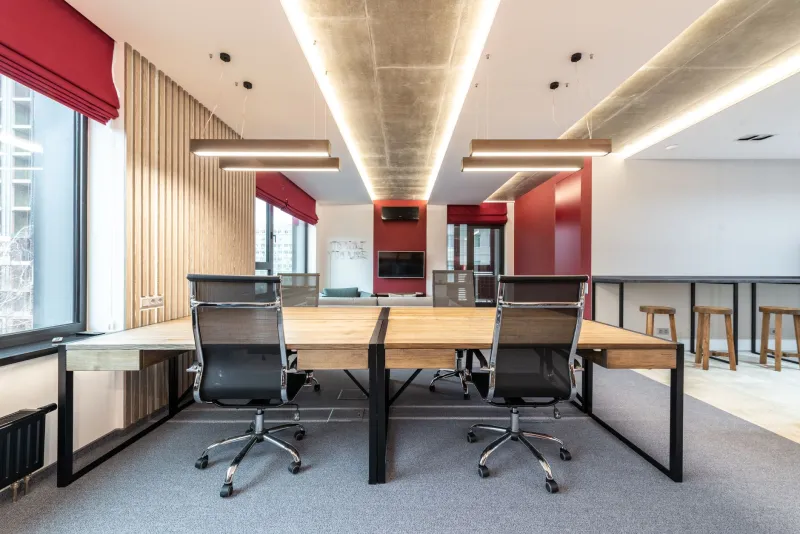
Consider how this plays out in practice. A professional services firm in Chicago undertook a comprehensive workplace redesign following a period of elevated voluntary turnover and declining scores on internal engagement surveys. Rather than addressing these issues through compensation adjustments alone, the firm invested in a reconfigured office environment that included designated quiet zones for deep-focus work, collaboration neighborhoods equipped with integrated audiovisual technology for seamless hybrid meetings, and biophilic design elements—natural light, indoor greenery, and materials chosen for acoustic performance—throughout the space.
The results, measured over 18 months, included a 22 percent reduction in voluntary attrition, a meaningful improvement in project delivery timelines attributed to more effective in-person collaboration, and a notable increase in employee net promoter scores. The firm's leadership did not view these outcomes as evidence that employee experience had come at the expense of performance. They viewed them as evidence that investing in experience had driven performance.
Technology as the Connective Tissue
No discussion of modern workplace strategy is complete without acknowledging the role that integrated technology plays in making the employee experience and operational efficiency mutually reinforcing. The smartest office environments in the United States today are not defined by their furniture or their floor plans alone—they are defined by the degree to which technology makes the space responsive, transparent, and efficient for everyone who uses it.
Room and desk reservation platforms eliminate the friction of finding available space, which sounds like a minor convenience but has meaningful implications for how employees experience their time in the office. When workers can arrive knowing exactly where they will be working and where their team is located, the psychological overhead of navigating an unfamiliar or disorganized environment is removed. That cognitive bandwidth is redirected toward actual work.
Occupancy sensors and workplace analytics dashboards give facilities and operations teams the data they need to continuously refine the environment—identifying underperforming spaces, anticipating peak-demand periods, and making evidence-based adjustments rather than reactive ones. Environmental controls that automatically adjust lighting and temperature based on occupancy levels contribute both to employee comfort and to energy efficiency, delivering value across two dimensions simultaneously.
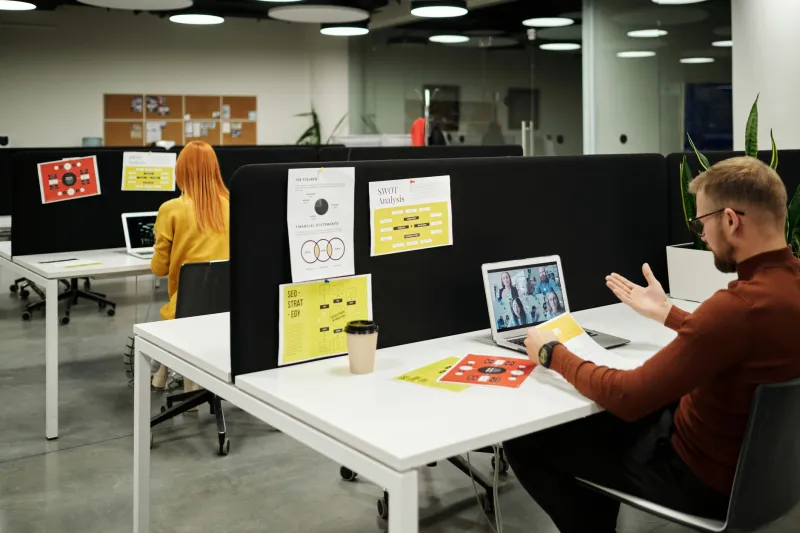
For hybrid workforces specifically, the quality of the technology experience in the physical office has become a significant factor in whether employees choose to come in at all. A meeting room that reliably connects remote participants with in-room attendees, without technical friction, makes the office a more compelling destination. A room that routinely fails on that front sends employees the opposite message.
Wellness Design Is Not a Luxury—It Is a Performance Variable
The wellness dimension of workplace design deserves particular attention because it is the area most likely to be dismissed as discretionary. In reality, the research connecting physical environment to cognitive performance is substantial and consistent.
Natural light exposure has been linked to improved sleep quality and alertness among office workers. Access to outdoor views and greenery is associated with reduced stress and improved concentration. Acoustic design—controlling unwanted noise through appropriate materials, spatial planning, and sound masking systems—has a direct effect on the ability to perform focused, complex cognitive tasks. These are not soft benefits. They are performance variables that show up in the quality of work employees produce.
Organizations that treat wellness design as a strategic investment rather than an aesthetic preference are finding that the returns are measurable. Reduced absenteeism, lower healthcare utilization among employees, and improved retention—particularly among high-performing individuals who have options and will leave environments that do not support their effectiveness—all translate into hard financial value.
Rethinking the Metrics
Part of why the false trade-off persists is that the metrics organizations use to evaluate workplace investments have historically been too narrow. Cost per square foot, utilization rates, and facility overhead are important, but they do not capture the full value equation.
Enterprises that are succeeding in integrating employee experience with operational performance are expanding their measurement frameworks to include employee retention costs avoided, time-to-productivity for new hires, collaboration quality indicators, and absenteeism trends alongside traditional real estate and facility metrics. When the full picture is visible, the return on thoughtful workspace investment becomes considerably easier to defend.
The conclusion that emerges from both the data and the enterprise case studies is straightforward: organizations do not have to choose between supporting their people and driving their performance. In the modern office, those goals are the same goal. The businesses that recognize this earliest will hold a meaningful and compounding advantage over those still treating the two as mutually exclusive.