Paying for Empty Desks: How Hybrid Work Is Exposing the Cracks in Corporate Real Estate Strategy
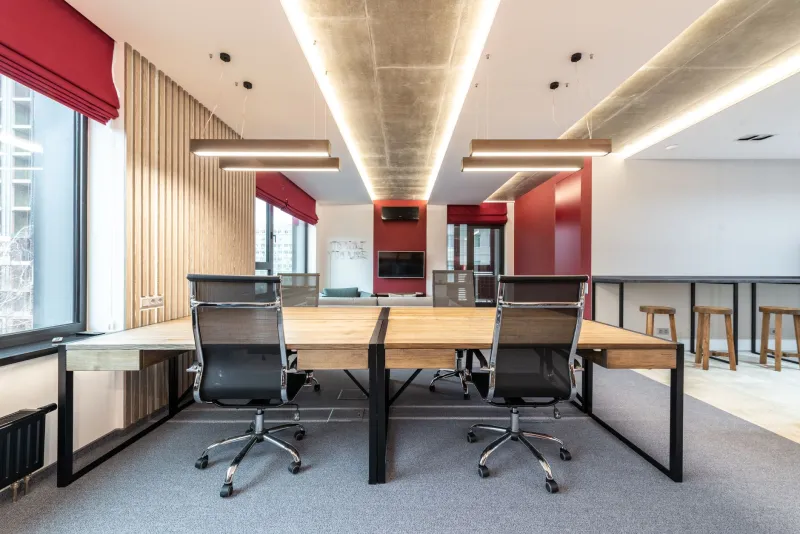
Walk through the average corporate office on a Wednesday afternoon and you will likely notice something unsettling: rows of empty workstations, conference rooms booked but unoccupied, and common areas that feel more like a ghost town than a thriving enterprise hub. This is not a scheduling anomaly. For thousands of American businesses, it is the new normal—and it is costing them far more than they realize.
Hybrid work arrangements, now standard across industries from financial services to technology and professional consulting, were adopted rapidly and in many cases without a corresponding revision to real estate footprints. The result is a growing mismatch between the space companies are paying for and the space their employees are actually using. According to workplace analytics research, average office utilization rates in the United States hover between 40 and 60 percent on peak days, dropping considerably lower mid-week and on Fridays. Yet lease obligations remain fixed, facility costs continue to accumulate, and capital that could be deployed toward growth is instead subsidizing vacant square footage.
The Miscalculation at the Heart of the Problem
The core error most enterprises made when transitioning to hybrid models was treating the office as a static asset rather than a dynamic resource. Pre-pandemic space allocations were built on the assumption that the majority of employees would be present the majority of the time. Hybrid schedules shattered that assumption, but real estate portfolios were not recalibrated accordingly.
Many organizations simply gave employees the flexibility to work from home without conducting any rigorous analysis of what that flexibility would mean for physical space demand. The question was never asked: if only 60 percent of our workforce is in the office on any given day, do we still need 100 percent of our current square footage? In most cases, the honest answer is no.
Compounding the problem is the uneven distribution of in-office attendance. Employees tend to cluster on Tuesdays and Thursdays, creating artificial peak-demand days while leaving Monday, Wednesday, and Friday underutilized. This pattern makes simple headcount-to-desk ratios misleading and argues strongly for a more nuanced approach to space planning.
Occupancy Analytics: Seeing the Office as It Actually Is
The first step toward a smarter real estate strategy is visibility. Enterprises cannot right-size what they cannot measure. Occupancy analytics platforms—ranging from badge-access data analysis to sensor-based monitoring systems—give facility and operations teams an accurate, real-time picture of how space is being used across an entire portfolio.
These tools move organizations beyond anecdotal observation and into evidence-based decision-making. Rather than relying on assumptions about how many people might show up on a given day, leadership teams can access granular data on desk utilization rates by floor, meeting room booking versus actual occupancy, peak and off-peak attendance patterns, and neighborhood-level traffic within a building.
With this data in hand, the path forward becomes considerably clearer. A company operating a 200,000-square-foot headquarters that consistently sees 55 percent utilization has a defensible, data-backed case for consolidating into a 120,000-square-foot space—or for restructuring how the existing space is configured to serve actual demand patterns rather than legacy assumptions.
Activity-Based Working as a Right-Sizing Tool
Occupancy analytics often reveal that the problem is not simply too much space, but the wrong kind of space. Many offices were designed around individual assigned workstations, a model that serves a fully in-office workforce but becomes highly inefficient under hybrid arrangements.
Activity-based working (ABW) offers a more adaptive framework. Rather than assigning every employee a permanent desk, ABW environments provide a variety of work settings—focused work zones, collaborative project spaces, informal lounge areas, and private call booths—calibrated to the actual activities employees need to perform when they are on-site.
This model allows organizations to accommodate a meaningful percentage of their workforce in a smaller overall footprint, because not every employee needs a dedicated workstation simultaneously. It also tends to improve the employee experience, as workers can choose environments that match their tasks rather than being tethered to a single assigned seat regardless of what their day requires.
For enterprises exploring ABW, the transition requires thoughtful change management, clear communication about how the new environment functions, and technology support such as desk reservation systems and room booking platforms that make it easy for employees to find and claim the right space at the right time.
Strategic Lease Negotiation in a Shifted Market
Beyond internal space reconfiguration, the current commercial real estate climate in the United States presents a genuine opportunity for enterprises willing to engage proactively with their lease obligations. Office vacancy rates in major metropolitan markets—including New York, Chicago, San Francisco, and Dallas—remain elevated by historical standards, shifting negotiating leverage toward tenants in ways that were not possible five years ago.
Organizations approaching lease renewals or new agreements should be pursuing several strategic objectives. First, flexibility clauses that allow for square footage adjustments as workforce patterns evolve are increasingly negotiable in today's market. Second, shorter initial lease terms with renewal options reduce long-term exposure to space that may no longer align with future needs. Third, landlord concessions—including tenant improvement allowances that can fund workspace redesign aligned with hybrid working models—are more accessible than they have been in decades.
Engaging a commercial real estate advisor with specific expertise in corporate portfolio optimization, rather than treating lease negotiations as a routine administrative function, can yield substantial savings and structural advantages that compound over the life of an agreement.
Aligning Space With Strategy
Ultimately, the enterprises that will manage real estate most effectively in the hybrid era are those that stop treating office space as a fixed overhead category and start treating it as a strategic variable. Space decisions should be driven by workforce data, aligned with business objectives, and reviewed on a regular cadence rather than revisited only when a lease comes up for renewal.
Right-sizing is not about cutting space for its own sake. It is about ensuring that every dollar invested in the physical workplace delivers measurable value—whether through enabling collaboration, supporting focused work, or reinforcing company culture. When occupancy data, space design, and lease strategy work in concert, the office becomes a precision tool rather than a sunk cost.
For organizations ready to close the gap between what they are paying for and what they are actually using, the analysis starts with an honest look at the numbers. The data, in most cases, will tell a story that demands action.